
Companies regularly accumulate old laptops after employee upgrades, IT refresh cycles, office closures, project completion, mergers, acquisitions or lease expiry. Instead of keeping unused laptops in storage, businesses can sell old corporate laptops in Bangalore through a structured laptop buyback process and recover value from equipment that is no longer required.
SparkonDigiTech provides corporate laptop buyback in Bangalore. Call or WhatsApp +91 98451 41787 for a quote.
However, selling 10, 50, 100 or 500 corporate laptops is very different from selling a single personal laptop. A corporate laptop sale requires attention to asset ownership, laptop model and configuration, physical condition, battery health, data security, asset records, lease status, GST documentation, valuation, pickup logistics, payment, data destruction, and disposal of non-working equipment.
Quick Answer: How Can a Company Sell Old Laptops in Bangalore?
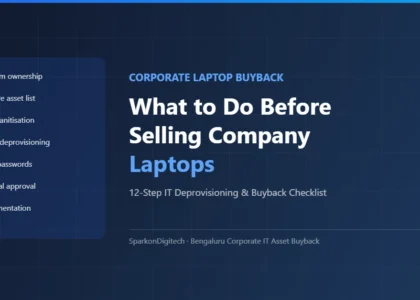
A company can sell old corporate laptops through a structured buyback process: (1) Prepare the laptop inventory — record brand, model, serial number, processor, RAM, storage and condition. (2) Confirm ownership — ensure the company has the legal right to sell, particularly for leased assets. (3) Separate by condition — group working, damaged, non-working and obsolete laptops. (4) Secure company data — follow the company’s approved data sanitisation process. (5) Request a buyback quotation — share the asset list with a corporate laptop buyer. (6) Arrange physical inspection — for larger quantities. (7) Finalise commercial terms — confirm price, GST, payment, pickup, documentation and data-destruction requirements. (8) Handover with device-level serial-number records. (9) Obtain payment and documentation. (10) Route working devices for refurbishment/reuse, non-recoverable equipment for responsible e-waste processing.
Why Do Companies Sell Old Laptops?
1. IT Refresh Cycle
Companies periodically replace older laptops with newer devices. Old fleet → New fleet → Old laptops become surplus assets. Instead of storing them indefinitely, the company can evaluate whether they still have resale value.
2. Employee Laptop Upgrades
When employees receive newer laptops, their previous devices may become surplus and can potentially be redeployed, sold, refurbished, donated or recycled.
3. Lease-Expired Laptops
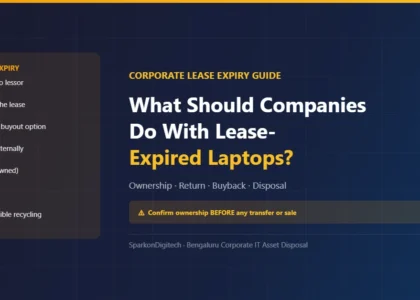
Before selling lease-expired laptops, the organisation must confirm lease agreement status, ownership, purchase option, residual obligations, and lessor requirements. Do not sell leased equipment unless the company has the legal right to dispose of it.
4. Office Closure / Project Completion / Business Restructuring
When a branch closes or a project ends, IT equipment can become surplus quickly. A corporate buyback process can help consolidate laptops, desktops, monitors, docking stations, servers, networking equipment and accessories. Mergers, acquisitions, downsizing and workforce changes can also create surplus IT assets where selling suitable equipment recovers value while reducing storage requirements.
Which Corporate Laptops Can Be Sold?
Most business laptop brands can potentially be considered for buyback, depending on model, age, condition and market demand — including Lenovo ThinkPad, Lenovo ThinkBook, Dell Latitude, Dell Precision, HP EliteBook, HP ProBook, HP ZBook, ASUS business laptops, Acer business laptops, Microsoft Surface devices, and Apple MacBook. The actual buyback value varies significantly by model and configuration.
Can Companies Sell Damaged or Non-Working Laptops?
Yes. Damaged laptops with broken displays, faulty keyboards, dead batteries, damaged hinges, missing chargers, SSD failures, charging problems, motherboard faults, cracked chassis, or that are not powering on may still have value. Non-working laptops can contain recoverable components such as display panels, RAM, SSDs, keyboards, fans, hinges, speakers, chassis components, motherboards, and cables. For very old or severely damaged devices, material recovery or authorised e-waste processing may be more appropriate than resale.
How Much Are Old Corporate Laptops Worth?
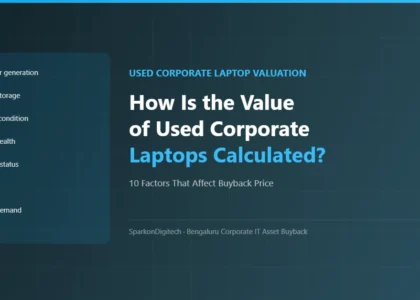
There is no single fixed price. Buyback valuation depends on brand, model, processor generation, RAM, SSD capacity and condition, display condition, battery health, keyboard and chassis condition, quantity, age, accessories, market demand, and refurbishment cost. A company should obtain a quotation based on the actual asset list, rather than relying on a generic online price.
What Information Should You Give a Corporate Laptop Buyer?
Provide laptop identification (brand, model, generation, serial number, asset tag), configuration (processor, RAM, SSD/HDD capacity, display size, OS), condition (working status, screen, keyboard, battery, hinge, chassis), accessories (charger, docking station, bag), and commercial information (quantity, location, expected pickup date, GST/company details, required documentation).
Example Corporate Laptop Buyback Inventory
| Asset Tag | Brand | Model | Config | Condition | Charger |
|---|---|---|---|---|---|
| SPK001 | Lenovo | ThinkPad T14 | i5/16GB/512GB | Good | Yes |
| SPK002 | Dell | Latitude | i5/16GB/512GB | Good | Yes |
| SPK003 | HP | EliteBook | i5/8GB/256GB | Fair | Yes |
| SPK004 | Lenovo | ThinkPad | i5/8GB/256GB | Not working | No |
Data Security Before Selling Corporate Laptops
Data security should be treated as a critical part of corporate laptop disposal. A company should follow its internal information-security and data-destruction policy before transferring equipment. Potentially sensitive information can remain on SSDs, HDDs, recovery partitions, cached accounts, browser profiles, local user accounts, corporate applications, and enterprise management systems. Simply deleting files is not an adequate data-security strategy, and a normal factory reset should not automatically be assumed to satisfy an organisation’s data-destruction requirements.
What About Microsoft Intune or MDM?
Corporate laptops may be enrolled in Microsoft Intune, Microsoft Entra ID, Active Directory, or other MDM systems and endpoint security platforms. Before transferring ownership, the company’s IT administrator should confirm that the device has been properly removed from relevant enterprise management systems — otherwise, a refurbished device may remain associated with the previous organisation. This should be handled by the company’s authorised IT administrator rather than simply relying on a buyer to remove corporate management controls.
How Does the Corporate Laptop Buyback Process Work?
Stage 1 — Enquiry: Company provides quantity, models, configuration, condition, location.
Stage 2 — Preliminary Evaluation: Buyer reviews inventory and provides indicative assessment.
Stage 3 — Physical Inspection: For larger quantities, buyer may inspect at company premises.
Stage 4 — Final Valuation: Price confirmed after physical condition and configuration are verified.
Stage 5 — Commercial Agreement: Parties confirm quantity, price, GST, payment, pickup, documentation, and data-security requirements.
Stage 6 — Handover: Assets handed over with serial-number records.
Stage 7 — Data Sanitisation/Processing: Agreed data-security process completed.
Stage 8 — Payment and Documentation: Company receives agreed payment and required commercial/asset documentation.
Selling Laptops in Bulk: 50, 100, 500 or More
Bulk sales are priced and handled differently from single devices. Buyers price the whole lot, so the way you prepare it directly affects the offer you receive.
What bulk buyers evaluate
- Lot consistency: identical models and generations are faster to test and resell than mixed lots, which are usually priced lower. Group your fleet by model and specification before asking for a quote.
- Processor generation: the biggest single driver of resale value. Very old generations may be worth more as parts than as complete laptops.
- Working vs non-working ratio: separate working, working-with-issues and non-working units. Non-working devices still have parts value but are priced on a different basis.
- RAM and storage: 16GB RAM and SSDs are preferred; hard-drive models are worth less. Check the configuration actually installed, not the original specification.
- Condition grade: Grade A (no marks) and Grade B (light wear) fetch the best prices; Grade C (noticeable wear) sells at a discount; Grade D (cracked screen, broken hinge) is often valued for parts.
- Accessories: include original chargers and docks in the inventory rather than separating them before the assessment.
What to expect by quantity
| Quantity | Typical approach | Approximate timeline |
|---|---|---|
| 10–50 laptops | Asset list and photos; remote estimate with a brief on-site check | 1–2 weeks to collection |
| 50–100 laptops | On-site assessment before the final offer; plan data wiping with your IT team | 2–3 weeks to payment |
| 100–500 laptops | Run it as a small project: full asset register, staged assessment, possibly several pickups | 3–6 weeks |
| 500+ laptops | Formal project with a named lead, phased data wiping and collection, full documentation | 4–8 weeks |
These timelines assume your internal preparation (inventory, approvals and data wiping) runs in parallel. Completing it first is the quickest way to shorten the sale.
Agree these points before pickup
- Who performs data wiping (your team or the buyer) and what record you will receive
- Whether pricing is per unit or per lot, and how non-working units are priced
- Collection logistics: number of trips, building access and packing
- Documents: handover sheet with serial numbers, GST invoice, payment confirmation, and disposal records for anything recycled
Ready to sell a fleet? See our corporate laptop buyback service in Bangalore for pickup, valuation and documentation.
How to Sell Lease-Expired Corporate Laptops
Before selling: check the lease agreement to determine whether the company must return the equipment, can purchase it, or has already exercised a purchase option; confirm ownership with documentation showing the company’s right to sell; prepare the asset list with serial numbers; obtain a buyback quotation with complete fleet information; and complete the transfer with appropriate commercial and asset documentation.
Corporate Laptop Buyback vs E-Waste Recycling
Not every old laptop should immediately go into recycling. A useful approach: working laptop → Buyback/resale/reuse; repairable laptop → Refurbishment/repair/resale; parts-value laptop → Component recovery; non-recoverable equipment → Responsible e-waste processing. This approach can potentially maximise value while ensuring genuinely end-of-life equipment is handled appropriately.
What Documents Should a Company Ask For?
Potential documents include: quotation, purchase order, asset handover sheet, serial-number list, GST invoice, payment confirmation, data sanitisation/destruction record, recycling/disposal certificate where applicable, and ownership/transfer documentation. Corporate procurement and finance teams should define their documentation requirements before the transaction.
How to Choose a Corporate Laptop Buyback Company in Bangalore
Check: corporate experience (does the company regularly handle business laptop fleets?), bulk capability (can they handle 20, 50, 100+ devices?), transparent valuation methodology, data-security process, documentation capability, pickup capability (collection from your Bangalore office), non-working equipment evaluation, e-waste handling for devices with no meaningful resale value, payment terms, and clear ownership transfer.
How to Get Better Value for Old Corporate Laptops
- Provide accurate specifications — “Lenovo ThinkPad T14 Gen 3, i5, 16GB, 512GB SSD, 30 units” instead of “Lenovo laptop – 50 units”
- Include chargers — complete devices are generally easier to evaluate
- Separate working and non-working units — avoid mixing very different conditions
- Provide serial numbers — makes asset verification easier
- Group identical models — speeds up assessment
- Don’t hide damage — transparent information reduces disputes during physical inspection
Sell Old Corporate Laptops in Bangalore
SparkonDigitech provides corporate laptop buyback and IT asset-disposal support for businesses in Bengaluru. For a quotation, share: laptop brand + model + quantity + configuration + condition + Bangalore pickup location.
Phone: +91 98451 41787 | Email: sales@sparkondigitech.com
How SparkonDigitech Can Help Companies Sell Old Laptops in Bangalore
SparkonDigitech provides corporate IT sales and services in Bengaluru, including corporate laptop buyback and IT asset disposal. Companies can approach SparkonDigitech for requirements involving old corporate laptops, surplus laptops, lease-expired laptops, working laptops, damaged laptops, non-working laptops, and mixed-brand corporate fleets. For an initial evaluation, provide: brand, model, quantity, configuration, condition, and location. SparkonDigitech can evaluate the requirement and confirm the applicable buyback value, pickup process, inspection process, payment terms, documentation, data-security requirements, and disposal options for non-recoverable equipment.
Actual valuation depends on the laptop model, age, configuration, condition, quantity and prevailing market demand.
Address: 696, 4th Main Rd, BEML Layout, 5th Stage, Rajarajeshwari Nagar, Bengaluru – 560098
Phone: +91 98451 41787
Email: info@sparkondigitech.com | sales@sparkondigitech.com
Website: sparkondigitech.com
Related guides: How the value of used corporate laptops is calculated · What to do with lease-expired laptops · Corporate laptop buyback checklist: what to do before selling
Frequently Asked Questions
How can I sell old corporate laptops in Bangalore?
Prepare an asset list containing the laptop model, quantity, configuration, serial number and condition, then approach a corporate laptop buyback company for an evaluation and quotation.
Can companies sell 50 or 100 old laptops at once?
Yes. Corporate buyback services are designed to handle bulk quantities. Larger fleets generally benefit from a structured inventory and physical assessment.
Can I sell lease-expired corporate laptops?
Yes, provided your company legally owns the equipment or has the contractual right to sell it. Confirm the lease and purchase status before disposal.
How is an old corporate laptop valued?
Value generally depends on model, processor generation, RAM, storage, display, battery, physical condition, functionality, quantity, accessories and current market demand.
Can I sell damaged corporate laptops?
Yes, depending on the buyer and the extent of damage. Repairable laptops and parts may retain value.
Should I delete company data before selling a laptop?
Your organisation should follow its approved data-security and data-sanitisation procedure before transferring equipment. Do not rely solely on manually deleting files.
Is a factory reset enough before selling a corporate laptop?
A factory reset should not automatically be considered sufficient for every corporate data-security requirement. Follow your company’s approved sanitisation policy and confirm the required process for the storage technology and data sensitivity.
Can companies sell Dell, HP and Lenovo laptops together?
Yes. A corporate buyer can evaluate mixed-brand fleets, although grouping assets by brand and model makes the assessment easier.
Should we repair laptops before selling them?
Not necessarily. Obtain an as-is valuation first and compare it with the expected value after repair minus repair costs before spending on refurbishment.
Does SparkonDigitech buy old corporate laptops in Bangalore?
SparkonDigitech provides corporate laptop buyback and IT asset-disposal services in Bengaluru. Companies can submit their laptop inventory for evaluation and receive confirmation of applicable valuation, pickup, documentation and other transaction requirements.
Need help with this for your company? See our corporate laptop buyback in Bangalore page, or call +91 98451 41787 (Mon–Sat, 10 AM–7 PM).