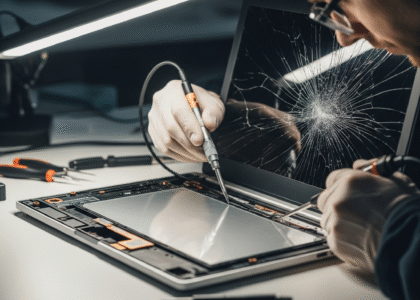

Of all the ways to spend money on an ageing laptop fleet, replacing mechanical hard drives with solid-state storage is the one most likely to surprise people. A machine written off as unusably slow frequently turns out to have been waiting on its disk the whole time.
SparkonDigiTech provides laptop repair for businesses in Bangalore. Call or WhatsApp +91 98451 41787 for a quote.
That said, “put an SSD in it” has become advice people give reflexively, and it is not always right. Three quite different upgrades get called the same thing, and only one of them is transformative.
Quick Answer
Replacing a mechanical hard drive with a solid-state drive produces a dramatic improvement and often adds two or three usable years to an otherwise sound laptop. Replacing an existing SATA SSD with an NVMe drive produces a much smaller real-world gain. Increasing capacity on a drive that is already solid-state produces no speed benefit at all. Replace the machine instead when it is already past your refresh point, when the bottleneck is elsewhere, or when the chassis itself is failing.
The three upgrades people call “an SSD upgrade”
| Upgrade | Real-world effect | Worth doing? |
|---|---|---|
| Mechanical hard drive → SSD | Transformative. Boot times, application launches and general responsiveness change completely | Almost always, if the machine is otherwise sound |
| SATA SSD → NVMe SSD | Measurable in benchmarks, modest in daily office use. Noticeable mainly with large file transfers | Only for genuinely storage-heavy workloads |
| Smaller SSD → larger SSD | No speed benefit. Solves a capacity problem only | When the drive is full, not when the machine is slow |
The confusion matters because someone whose machine already has a SATA SSD may be told an “SSD upgrade” will fix their slow laptop, and be disappointed. Establish which of these three you are actually considering before costing anything.
When an SSD will not fix it
Storage is one of four common causes of a slow laptop. Before ordering a drive, rule out the others:
- Insufficient memory. If the system is paging heavily, an SSD makes the paging faster but does not stop it. Our RAM upgrade guide covers how to check this in Task Manager.
- Thermal throttling. A dust-clogged machine reduces its own processor speed to stay cool. Cleaning is the fix.
- Software. Startup items, background sync clients and layered security software.
- The processor itself, on genuinely old machines running current software.
The useful diagnostic: in Task Manager’s Performance tab, sustained high disk activity with modest processor use points at storage. High memory use alongside it points at memory. Both can be true, and on an old machine with a mechanical drive they usually are.
Checking what your laptop can take
Before ordering, confirm four things about the specific machine:
- Interface. Whether the slot is SATA or supports NVMe. Some machines have an M.2 slot that only speaks SATA — an NVMe drive fitted there will not work, or will run at SATA speed.
- Form factor. 2.5-inch or M.2, and if M.2, the physical length — 2280 is common but not universal.
- Keying. M.2 drives use different notch positions. The wrong key will not fit.
- Slot availability. Whether the machine has a spare slot, or whether the existing drive must come out.
As with memory, identify the machine by the model and machine type designation on the underside label rather than the marketing name, since one model name often covers several internal configurations.
The part everyone underestimates: the data
Fitting the drive is the quick part. Deciding what happens to the contents is the project.
Cloning copies the existing installation onto the new drive. The user’s environment survives intact and downtime is minimal. It also carries across whatever accumulated clutter was contributing to the slowness.
A clean install gives a genuinely fresh machine, which usually performs better than a clone. It costs more time — reinstalling applications, restoring data, reconfiguring settings — and requires that you actually know what was on the machine.
For a single machine belonging to a user with a complex environment, cloning is usually pragmatic. For a fleet upgrade where machines are standardised and centrally imaged, a clean install is normally better and not much slower per machine.
Either way, back up first. Drive migrations are exactly the moment at which unbacked-up data gets lost, and if the existing drive is already failing, that risk is higher than usual. Where a drive has already failed, data recovery is a separate exercise that should happen before any upgrade work.
Fleet-wide upgrades: how to plan one
- Audit which machines still have mechanical drives. These are your candidates; machines already on SSDs generally are not.
- Check lifecycle position. A machine within a year of its refresh point is usually not worth upgrading.
- Verify on one machine before ordering in quantity — interface, form factor and keying confirmed in practice.
- Decide clone or rebuild, consistently across the batch.
- Schedule in groups, using spare machines to keep people working during the swap.
- Record the change against each asset, including what happened to the old drive.
- Dispose of the old drives properly. They contain company data and need sanitising or destruction, not a desk drawer.
That last point is worth emphasising. A fleet SSD upgrade generates a pile of drives holding complete copies of company data, and it is remarkably common for them to sit in a cupboard indefinitely.
When to replace the laptop instead
- The machine is already at or past your planned refresh point.
- Storage is not the actual bottleneck.
- The chassis is failing — hinges, ports, keyboard, screen.
- The processor cannot keep up with the role’s software regardless of storage.
- The operating system it supports is nearing the end of security updates.
- The machine also needs memory it cannot take, because the memory is soldered.
The broader framework for that decision is in our guide to repair versus replacement.
How SparkonDigitech can help
SparkonDigitech handles storage upgrades, backup and data migration for business laptops in Bengaluru. We can confirm which interface and form factor a specific model takes before you order, advise whether cloning or a clean install suits your situation, and handle secure disposal of the drives that come out.
Frequently asked questions
Will an SSD make my old laptop faster?
If it currently has a mechanical hard drive, yes — usually dramatically, since storage is the dominant bottleneck on those machines. If it already has a solid-state drive, a newer SSD will make very little difference to everyday work, and the cause of the slowness is likely memory, thermal throttling or software.
Is it worth upgrading the SSD on a five-year-old laptop?
It depends on where the machine sits in your refresh cycle and on the rest of its condition. If it is otherwise sound, still adequate for the role, and has a year or more of intended service left, an upgrade is usually good value. If it is already due for replacement, the upgrade mostly buys a short extension.
What is the difference between SATA and NVMe SSDs?
They use different interfaces and protocols. NVMe drives offer considerably higher peak throughput, which shows clearly in benchmarks and in large file transfers, but much less in typical office work. Importantly, not every M.2 slot supports NVMe — some are SATA-only, so the slot must be checked before ordering.
Should we clone the old drive or do a clean install?
Cloning preserves the user’s environment and minimises downtime but carries over existing clutter. A clean install generally produces a better-performing machine but takes longer per unit. For standardised fleets with central imaging, clean installs are usually the better choice.
What should we do with the old hard drives?
Treat them as data-bearing assets. They should be sanitised using an appropriate method, or physically destroyed, with a record of what happened to each one. They should not be stored indefinitely or discarded intact.
Can every laptop take an SSD upgrade?
Most can, but the specifics vary: interface, form factor, physical length and keying all have to match, and some machines have no spare slot. A few very thin models use soldered storage that cannot be replaced at all. Check the exact model and configuration before ordering.
The short version
If the machine has a mechanical hard drive and is otherwise sound, this is one of the best-value upgrades available to a corporate fleet. If it already has an SSD, the answer to a slow laptop is almost certainly somewhere else.
Considering SSD upgrades across your team? Speak to SparkonDigitech about compatibility and data migration.
Need help with this for your company? See our laptop repair for businesses in Bangalore page, or call +91 98451 41787 (Mon–Sat, 10 AM–7 PM).