
A company managing 100 laptops does not necessarily need 100 spare parts in stock. What it does need is a supplier who can accurately identify the right component for a specific laptop model and machine type, confirm availability, state the part condition clearly, document the transaction, and support repeat procurement reliably — so that when a repair is needed, the part arrives correctly specified the first time.
SparkonDigiTech provides laptop spare parts in Bangalore. Call or WhatsApp +91 98451 41787 for a quote.
Choosing the wrong supplier has a compounding effect. An incorrect part means a return, additional lead time, technician delays, extended device downtime, and a second procurement cycle — all at a cost that is invisible in the original part price comparison. For corporate IT teams managing 50 to 500+ laptops, supplier quality is a materials management decision, not just a purchasing one.
This guide provides a structured 15-point checklist for evaluating a laptop spare-parts supplier, along with component-specific questions, warning signs, and a recommended procurement workflow — for IT managers, procurement heads, AMC companies, system integrators and managed service providers.
How Do Companies Choose a Laptop Spare Parts Supplier?
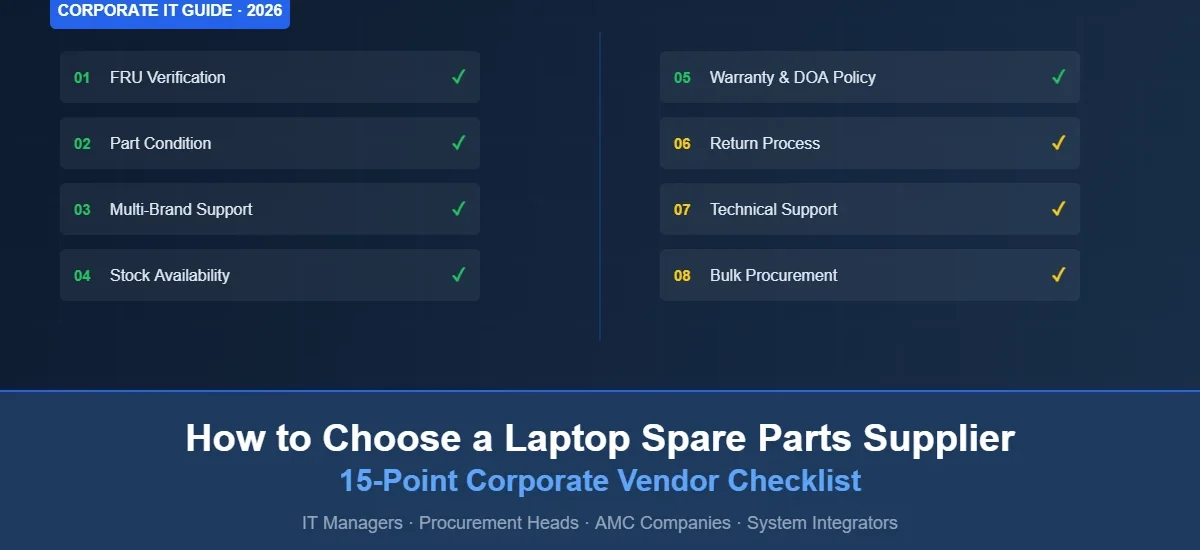
The right corporate laptop spare-parts supplier should be evaluated across these criteria before placing recurring or bulk orders:
- Verify exact laptop model and part/FRU number — not model name alone
- Confirm part condition: OEM/genuine, compatible, used/pulled, or refurbished
- Check physical and technical availability (ready stock or sourced on order)
- Review warranty period, coverage and DOA policy
- Confirm return and replacement process for incorrect or defective parts
- Verify GST invoice and commercial documentation capability
- Assess technical compatibility support — not just order-taking
- Evaluate bulk and recurring procurement capability
- Confirm delivery process, packaging and lead times
- Review vendor reliability for long-term fleet procurement
For a detailed guide to OEM vs compatible spare-parts decisions, see our article on OEM vs compatible laptop spare parts for companies. This checklist focuses on evaluating the supplier — not the part type.
15-Point Laptop Spare Parts Supplier Checklist for Corporate IT Teams
1. Exact Part Number / FRU Verification
A laptop model name identifies a product line, not a specific spare part. Within the same model family — for example, a ThinkPad L14 — there may be multiple keyboard variants (backlit/non-backlit, different layouts), battery configurations (different capacities), display options (FHD, IPS, touch/non-touch), and motherboard variants by CPU and GPU configuration. A supplier working from model name alone is operating with incomplete information.
The correct approach is FRU (Field Replaceable Unit) number or manufacturer part number verification. These are model-specific, revision-specific, and tied to the exact laptop machine type (MTM). The correct FRU for a component is found in the device’s hardware maintenance manual, available from the manufacturer’s support site. A professional supplier will request FRU confirmation before supplying a component — or will be able to help identify it from the machine type if the buyer does not have it to hand.
What to ask: Can you identify this part by FRU number? Do you need the machine type or MTM to confirm compatibility?
2. Part Condition: OEM / Genuine / Compatible / Used / Refurbished
Every part a supplier sells has a condition — and that condition should be disclosed clearly before purchase, not discovered on arrival. A corporate buyer needs to know what they are receiving before committing to an order.
| Part Type | Typical Use | Key Advantages | Key Risks | Confirm Before Ordering |
|---|---|---|---|---|
| OEM / Genuine | Warranty-covered devices, business-critical repairs | Exact spec, firmware compatible, manufacturer warranty | Higher cost, may be unavailable for older models | Manufacturer part number, warranty period |
| Compatible (new) | Out-of-warranty devices, lower-risk components | Lower cost, often widely available | Quality varies; verify compatibility, testing, warranty | FRU match, supplier testing, warranty terms |
| Used / Pulled | Ageing models, discontinued parts | Available for older models, lower cost | Unknown history; must be tested and graded | Source, testing, grade, warranty |
| Refurbished | Non-critical repairs, budget-constrained procurement | Lower cost, some remediation done | Refurbishment quality varies by supplier | What was replaced/tested, warranty |
The right condition is determined by the device’s age, warranty status, business criticality, and repair economics — not a single rule. See our OEM vs compatible guide for a full decision framework.
3. Multi-Brand Coverage
Corporate fleets are rarely single-brand. A supplier useful for recurring corporate procurement should be able to support the major business laptop brands your fleet includes. Relevant brands for most Indian corporate fleets include Lenovo (ThinkPad, IdeaPad, ThinkBook), Dell (Latitude, Vostro, Precision), HP (EliteBook, ProBook, ZBook), ASUS (ExpertBook) and Acer (TravelMate). Confirm specifically which brands and model families the supplier can support, rather than relying on a generic “all brands” statement.
4. Availability and Stock Status
A supplier may list a part as available in their catalogue or on a website, but the practical question is whether it is physically in stock or sourced on order after a request is placed. Both can be acceptable — but the lead time implication is different. A corporate IT team managing a device under repair needs to know: is this part ready to ship today, or will it take 5–7 days to source?
What to ask: Is this in ready stock? What is the expected dispatch time? Is availability confirmed for the specific FRU?
5. Warranty Terms and DOA Policy
A part warranty should answer several specific questions: what period is covered, what failure modes are included, what the dead-on-arrival (DOA) policy is, what the claim process looks like, and whether installation-related failures are covered or excluded. Vague warranty statements — “we provide warranty” without specifics — leave buyers exposed if a component fails. Corporate procurement requires defined warranty terms, not a verbal assurance.
What to ask: What is the warranty period? What does it cover? What is the DOA policy? How is a warranty claim processed?
6. Return and Replacement Policy
Wrong parts happen — particularly for buyers new to FRU-level verification. What matters is what the supplier does when a part arrives incorrect, damaged, defective, or incompatible. A supplier with a clear, written returns process reduces procurement risk significantly. Ask specifically: what happens if the wrong part is supplied? What if the part is defective after installation? Who bears return shipping cost?
7. Technical Compatibility Support
There is a meaningful difference between a supplier who takes part numbers and ships, and one who can help a buyer identify the correct component for a specific machine type. For corporate IT teams, the second type is more valuable — particularly for complex components like motherboards, display assemblies, or batteries where specification details require cross-referencing with the laptop’s service documentation. A technically capable supplier can verify model, generation, connector type, display resolution, battery voltage and keyboard layout before the order is placed, reducing the likelihood of incorrect parts.
8. Bulk and Recurring Procurement Capability
There is a qualitative difference between buying one part and establishing a recurring supply arrangement for a 100–500+ laptop fleet. A supplier suited to recurring corporate procurement should be able to: respond to structured quotation requests, support multiple lines in a single order, maintain consistency across repeated orders of the same part, and provide documentation aligned with corporate purchase-order processes. For fleet procurement frameworks by size, see our guide on spare-parts procurement for corporate laptop fleets.
9. GST Invoice and Documentation
Corporate procurement requires documentation. At minimum, a supplier should be able to provide: a formal quotation, a GST-compliant tax invoice, and delivery documentation. For AMC companies and system integrators managing client assets, part-level documentation — including part number, condition, quantity, and serial number where applicable — may be required for client reporting. A supplier who cannot provide a proper GST invoice is not suitable for formal corporate procurement.
10. Delivery, Packaging and Lead Times
Display assemblies, cooling fans, and motherboards require careful packaging — improper shipping of fragile components is a real risk. For companies with multiple office locations, the ability to deliver to different addresses for different orders matters. Lead times should be stated at point of quotation, not discovered at dispatch. For companies with urgent repair requirements, clarity on dispatch timelines allows IT teams to plan technician scheduling around part arrival.
11. Part Quality and Testing
For compatible, used and refurbished parts, buyers should ask specifically what testing was performed before the part was offered for sale. A compatible battery should have been tested for capacity, voltage and firmware compatibility. A used display should have been inspected for pixel integrity and backlight uniformity. A refurbished motherboard should have been powered and functionally tested. Asking specifically — “what testing was done on this part?” — distinguishes suppliers with genuine quality processes from those relying on visual inspection only.
12. Supplier Communication
The quality of a supplier relationship is visible in how they communicate: how quickly they respond to quotation requests, whether they ask the right clarifying questions (model, MTM, FRU), how they handle delivery updates, and how responsive they are when a warranty or return situation arises. For recurring corporate procurement, a supplier who communicates clearly and proactively reduces administrative overhead and procurement friction.
13. Recurring Procurement Support
Companies with ongoing fleet maintenance requirements benefit from suppliers who can maintain records of previously ordered parts — by model, FRU number, and condition — so that repeat orders are placed quickly and consistently. For AMC companies managing client SLAs, a supplier who understands recurring procurement timelines is operationally more valuable than one who treats each order as a first-time transaction.
14. Experience With Corporate IT and Fleet Environments
A supplier who understands IT procurement, AMC operations, fleet repair cycles, asset management documentation and multi-location requirements is better positioned to support a corporate buyer’s actual workflow. Relevant questions: does the supplier understand the difference between a single-device repair and a fleet procurement requirement? Can they support a formal purchase-order process? Do they understand AMC company procurement timelines?
15. Total Cost of Ownership — Not Just Part Price
The procurement cost of a spare part is not just its purchase price. Total cost includes: part price + delivery + technician time for installation + downtime cost if the part fails + return cost + re-procurement cost + extended repair cycle. A cheaper part that fails installation, requires two technician visits, and takes an extra week to replace has a higher total cost than a correctly specified part delivered at first attempt. For corporate procurement decisions, evaluating total cost — not just price — consistently produces better outcomes. See our laptop spare-parts guide for further guidance on cost evaluation.
Questions to Ask Before Ordering Common Laptop Spare Parts
Laptop Battery
- What is the voltage (V) and capacity (Wh/mAh)?
- What is the cell configuration and are cells new?
- Is firmware compatibility confirmed for this specific model and BIOS version?
- What is the warranty period and DOA policy?
- Is this OEM, compatible, or refurbished?
Laptop Display Assembly
- What is the exact screen size, resolution, and panel type (IPS/TN/OLED)?
- Is it touch or non-touch?
- What is the connector type and pin count?
- Is a display cable included or required separately?
- Is bracket/hinge mounting compatible?
Laptop Keyboard
- Is it backlit or non-backlit?
- What is the language and layout (US/UK/Indian regional)?
- What is the connector type?
- Is it keyboard-only or keyboard with palmrest assembly?
- What generation/revision is it from?
Laptop Charger / Adapter
- What is the output voltage and amperage/wattage?
- What is the connector size and type (barrel/USB-C PD)?
- Is USB-C Power Delivery compatible at the required wattage?
- Is this OEM or compatible?
Laptop Fan / Cooling Assembly
- Is this a CPU fan only or combined heatsink-fan assembly?
- What is the fan connector type and pin count?
- Is it compatible with the specific CPU/GPU configuration of this machine type?
Motherboard
- What is the exact FRU number and machine type?
- What CPU configuration is fitted?
- Is discrete GPU present or integrated graphics only?
- What BIOS/firmware considerations apply to the replacement?
- What is the condition (OEM new, used/tested, refurbished) and warranty?
Hinges, Body Parts and Cables
Physical compatibility is the primary concern for mechanical components. Hinge torque specification, display cable routing, and chassis-specific connector placement all vary across models and revisions. The FRU number or exact machine type is essential for ordering these correctly — physical dimensions alone are not a reliable guide.
10 Warning Signs You Should Reconsider a Laptop Spare Parts Vendor
- Cannot provide a part number or FRU number — a supplier who can only reference “model name” is not verifying compatibility at the component level
- Does not disclose part condition — OEM, compatible, used, refurbished: if this is not stated clearly before purchase, ask directly; if the answer is still vague, treat it as a risk
- Cannot confirm compatibility for the specific machine type — “fits most models” is not a compatibility confirmation for corporate procurement
- Cannot provide a written quotation — verbal pricing is not a basis for corporate purchase orders
- Warranty is undefined or verbal only — a professional supplier states warranty terms in writing; “we’ll handle it if there’s a problem” is not a warranty policy
- No documented returns or replacement process — the returns policy should be clear before, not after, a problem arises
- Delivery timeline is unspecified or changes after order — for fleet IT management, predictable lead times are operationally important
- Cannot provide GST-compliant documentation — this disqualifies the supplier from formal corporate procurement in most organisations
- Part specifications change at delivery — receiving a different voltage, capacity, layout or connector to what was quoted indicates poor inventory control or supplier substitution without notification
- Cannot support recurring orders — a supplier suitable for one-off purchases may not have the processes to support structured fleet procurement
Corporate Supplier Comparison: What to Look For
| Evaluation Area | Basic Supplier | Corporate-Ready Supplier |
|---|---|---|
| Part identification | Model name only | Model + FRU/part number verified |
| Condition disclosure | Sometimes unclear | OEM/compatible/used/refurbished stated clearly |
| Warranty | Unclear or verbal | Defined period, coverage and DOA policy |
| Bulk orders | Ad hoc, inconsistent | Structured quotation and order process |
| Documentation | Basic receipt | Quotation + GST invoice + delivery records |
| Technical support | Order-taking only | Compatibility assistance and specification guidance |
| Repeat procurement | Each order from scratch | Supplier maintains part history and preferred-part records |
| Multi-brand support | Variable and unconfirmed | Clearly defined brand and model coverage |
| Returns process | Informal, case-by-case | Written policy applied consistently |
| Fleet support | Limited to single-device orders | Designed for recurring corporate requirements |
Use this as a reference when evaluating a new supplier or reviewing an existing one. The criteria reflect what professional corporate procurement requires — not what the best available supplier in any given market will always provide.
Recommended Corporate Laptop Spare Parts Procurement Process
The following workflow applies to IT departments, AMC companies, system integrators and managed service providers managing structured fleet repairs:
- Identify the failed component through diagnosis
- Record laptop brand, model name and machine type (MTM)
- Record generation/revision (Gen 1, Gen 2, etc. where applicable)
- Locate the FRU/part number from the hardware maintenance manual or device label
- Determine quantity required and preferred part condition
- Request a written quotation from supplier(s), providing MTM and FRU number
- Verify compatibility, condition and warranty terms in the quotation
- Compare options across price, warranty and lead time — not price alone
- Confirm delivery timeline and address
- Issue purchase order with reference to FRU number and agreed specification
- Receive and physically inspect the part against the specification before installation
- Install and test — document any compatibility or quality observations
- Record part number, supplier, condition and warranty expiry for inventory tracking
- Log warranty claim process if required within the warranty period
- Maintain supplier performance history to inform future procurement decisions
This workflow is especially important for AMC companies and system integrators, where client SLA commitments depend on predictable repair cycles and supplier reliability.
How Supplier Requirements Change With Fleet Size
| Fleet Size | Primary Supplier Requirement |
|---|---|
| 10–50 laptops | Accurate part identification; occasional procurement; fast turnaround on common parts |
| 50–100 laptops | Repeat procurement capability; consistent quality for preferred part types; structured quotations |
| 100–500 laptops | Vendor management capability; multi-line orders; documentation for auditing; part history |
| 500+ laptops | Strategic sourcing capability; multi-location delivery; lifecycle-aware procurement; reliable availability |
Fleet size informs supplier selection, but it does not determine stock levels. Failure history, device models, age distribution and repair patterns within the fleet are equally important inputs. For a detailed framework, see our guide to laptop spare-parts procurement for 50, 100 and 500+ device fleets.
Laptop Spare Parts Procurement for Businesses in Bangalore
For companies in Bengaluru managing corporate laptop repair requirements — whether an in-house IT team, AMC company, system integrator or managed service provider — SparkonDigitech can support procurement enquiries for laptop spare parts across common business brands.
To request a quotation, provide: laptop brand, model name, machine type (MTM), FRU/part number if available, required condition (OEM/compatible/used), quantity and delivery location. This information allows a specific, accurate response.
For organisations that have structured AMC arrangements or ongoing fleet repair requirements, see our guides on laptop AMC services in Bangalore and corporate laptop repair services in Bangalore. For companies reviewing laptop lifecycle decisions alongside spare-parts costs, our corporate laptop buyback service handles end-of-life device disposal and recovery.
Request a Spare Parts Quotation
Share your requirements: laptop brand, model, machine type, FRU/part number, quantity, condition required, and delivery location. SparkonDigitech will respond with a specific quotation.
Phone: +91 98451 41787 | Email: sales@sparkondigitech.com
696, 4th Main Rd, BEML Layout, 5th Stage, Rajarajeshwari Nagar, Bengaluru – 560098
Frequently Asked Questions
Q: How do companies choose a laptop spare parts supplier?
Evaluate on: part-number accuracy (FRU verification), condition disclosure (OEM/compatible/used/refurbished), availability, warranty terms, return policy, GST documentation, technical compatibility support, bulk capability, and long-term reliability. Price is one factor among several — it should not be the primary filter.
Q: Is the laptop model number enough to order a spare part?
Not reliably. The same model name may span multiple generations, configurations and chassis revisions, each using different components. The machine type (MTM) and FRU/part number provide the specificity needed for accurate ordering. A supplier who only works from model name is operating with incomplete identification.
Q: What is an FRU number?
FRU stands for Field Replaceable Unit. A manufacturer-assigned identifier for a specific spare part, tied to specific laptop models, machine types and revisions. It is the most precise way to identify a component — more reliable than model name or part description alone. FRU numbers are listed in the laptop’s hardware maintenance manual, available from the manufacturer’s support website.
Q: What should I check before buying laptop spare parts in bulk?
Before bulk ordering: verify compatibility by FRU on a test unit, confirm part condition and warranty terms, test one unit before committing to quantity, check the supplier’s return policy for incorrect or defective parts, confirm GST documentation capability, and document the FRU number and supplier details for accurate repeat ordering.
Q: Should companies buy OEM or compatible laptop parts?
The right choice depends on device age, warranty status, component sensitivity, and business criticality. OEM parts are the safer default for warranty-covered devices, business-critical users, and power/firmware-sensitive components like batteries. Compatible parts from verified suppliers can be appropriate for out-of-warranty devices and lower-risk mechanical components. See our OEM vs compatible guide for a full decision framework.
Q: Can companies buy used or pulled laptop spare parts?
Yes, for appropriate use cases — typically ageing models where OEM parts are discontinued. Key requirements: confirmed functional testing, graded condition (A/B grade), stated warranty, and clear return policy. Used components should not be purchased untested or without grading for business-critical repairs.
Q: What warranty should a corporate spare-parts supplier provide?
Warranty terms should be specific and written: period covered, what failure modes are included, DOA policy, claim process, and any exclusions. “We provide warranty” without specifics is not a procurement basis. Corporate buyers should request warranty terms in writing before placing an order.
Q: What documents should a corporate buyer request from a spare-parts supplier?
At minimum: quotation with part specification and FRU number, GST-compliant tax invoice, delivery documentation. For AMC companies and system integrators: part-level records including condition, part number and warranty period, for client reporting and audit purposes.
Q: How can IT teams reduce wrong-part orders?
By providing FRU numbers at point of enquiry rather than model names only. The machine type (found on the base label) enables FRU identification. Keeping a simple register of FRU numbers for the most commonly replaced components in your fleet — by model and generation — eliminates the most common cause of incorrect parts.
Q: Can companies procure spare parts for multiple laptop brands from one supplier?
Some suppliers cover multiple major brands — Lenovo, Dell, HP, ASUS, Acer — but coverage varies by component type and model age. Confirm specifically which brands and model families the supplier can support rather than relying on a general statement. Test procurement on a single line before placing multi-brand orders.
Q: How should companies manage spare-parts procurement for a 100-laptop fleet?
Establish a three-tier inventory: critical stock (batteries, keyboards, adapters for primary models), planned stock (fans, hinges, display parts — replenished quarterly), and order-on-demand (motherboards, rare components). Use a single preferred supplier for consistency and document FRU numbers for all regularly-ordered parts. See our fleet procurement guide for a full framework.
Q: What information should I send a supplier before requesting a quotation?
Provide: laptop brand, model name, machine type (MTM), generation/revision, FRU or part number if known, required condition (OEM/compatible/used/refurbished), quantity, and delivery location. This enables a specific quotation rather than a generic price range that may not apply to your exact requirement.
Q: What should be included in a laptop spare-parts quotation?
A proper quotation should include: part description, FRU/part number, condition (OEM/compatible/used/refurbished), unit price, GST details, total amount, warranty terms, estimated delivery timeline, and return/replacement policy. Any quotation that omits condition or warranty terms should be clarified before ordering.
Q: How can a company find a reliable laptop spare-parts supplier in Bangalore?
Look for suppliers who can provide FRU-level identification (not just model names), clearly disclose part condition, state warranty terms in writing, issue GST invoices, and can support recurring procurement requirements. Ask about multi-brand coverage, bulk order capability and returns process before placing a first order. Suppliers based in Bengaluru may offer faster local availability for common corporate brands.
Need help with this for your company? See our laptop spare parts in Bangalore page, or call +91 98451 41787 (Mon–Sat, 10 AM–7 PM).